EN
EN



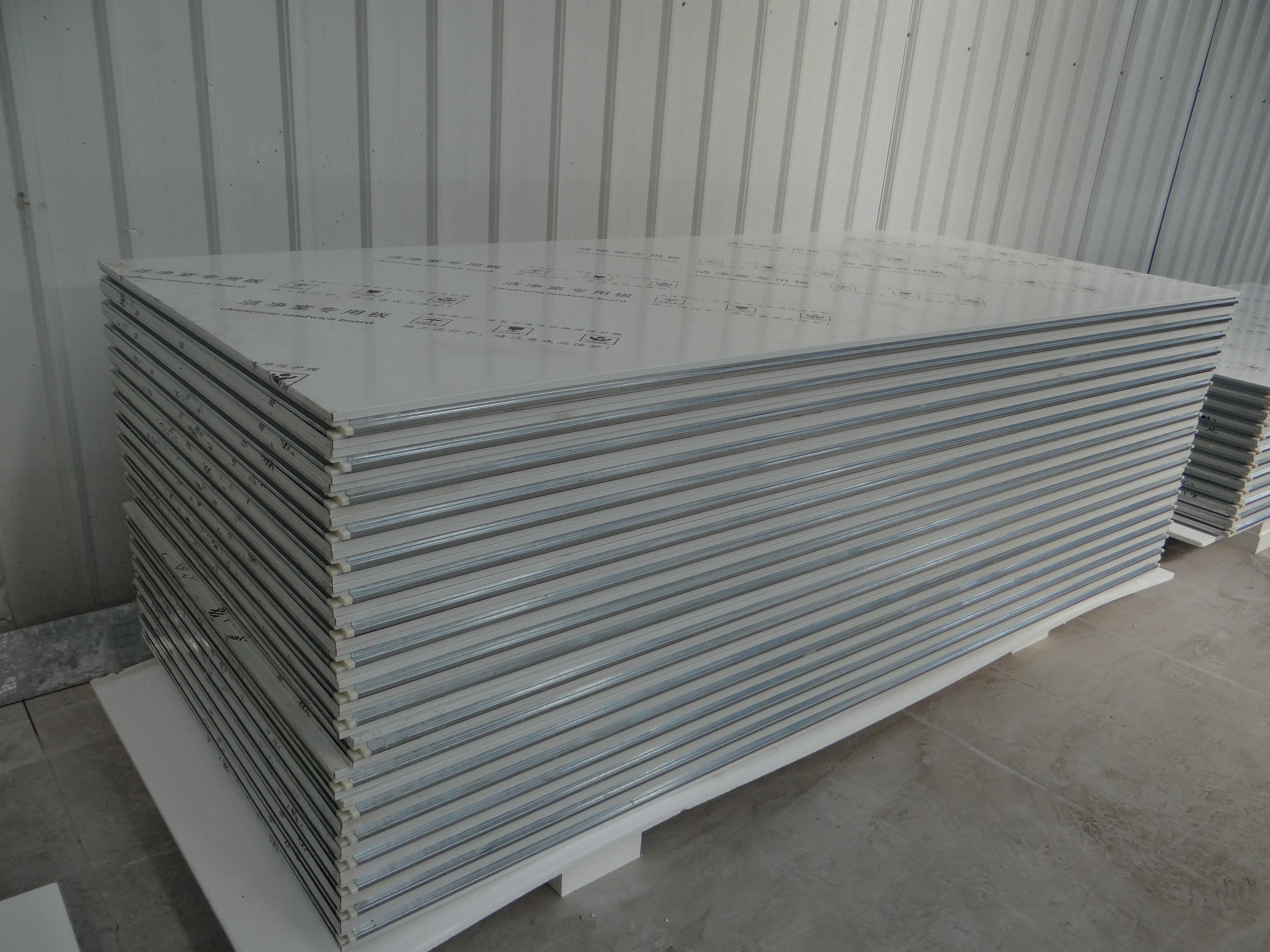
Superior Thermal Performance and Energy Efficiency of Insulated Metal Panels
How PIR/PUR Core Materials Minimize Heat Infiltration in Sub-Zero Environments
Insulated metal panels (IMPs) achieve superior thermal efficiency through their closed-cell polyisocyanurate (PIR) or polyurethane (PUR) foam core—materials recognized by ASHRAE and the U.S. Department of Energy for consistent, high-performance insulation. These cores deliver R-values up to R-7 per inch, significantly limiting conductive and convective heat transfer between sub-zero interiors and ambient environments. The continuous, factory-bonded foam layer eliminates air gaps while forming an integrated air, water, and vapor barrier—critical for preventing thermal bridging and condensation, two leading causes of envelope failure in cold storage. Compared to traditional glass fiber batts or spray-applied insulation, IMPs offer more than double the effective R-value per inch, ensuring stable, uniform temperatures even under sustained -40°C conditions.
Quantifiable Energy Savings: Case Study from a -25°C Frozen Logistics Hub
A frozen logistics hub operating continuously at -25°C retrofitted its building envelope with IMPs and achieved a 34% annual reduction in cooling load—translating to nearly $50,000 in annual energy savings. The airtight, monolithic assembly minimized infiltration losses, which account for up to 30% of total energy waste in conventional cold storage buildings, per data from the Cold Chain Federation and ENERGY STAR Commercial Buildings Program. Over five years, utility savings alone covered the initial IMP investment—a payback period aligned with industry benchmarks for high-efficiency envelope upgrades. Independent lifecycle analyses, including those published in ASHRAE Journal, confirm that IMPs can reduce overall HVAC energy demand by up to 40% compared to legacy insulation systems when properly specified and installed.
Unmatched Structural Integrity and Air-Tightness for Reliable Cold Storage
Seamless Steel Skins Eliminate Thermal Bridging and Prevent Condensation
Cold storage reliability hinges on structural continuity—not just insulation value. IMPs deliver this through uninterrupted steel skins bonded directly to the foam core, eliminating discrete fasteners, seams, and framing penetrations that create thermal bridges. Industry studies—including third-party thermal imaging assessments commissioned by the Metal Construction Association—show that such discontinuities can contribute to over 20% of total heat gain in conventional cold store walls. By contrast, IMPs’ seamless skin-to-core bond maintains thermal continuity across the entire panel surface. This airtight integrity also suppresses interstitial condensation: moisture-laden air cannot infiltrate the assembly to reach cold surfaces where dew point is exceeded. Accelerated material creep testing per ASTM C1657 confirms long-term dimensional stability across thousands of freeze-thaw cycles—ensuring consistent sealing performance without degradation. For high-humidity operations like blast freezing or produce ripening rooms, this durability directly safeguards food safety, structural integrity, and refrigeration efficiency.
Versatile Applications Across Cold Storage Temperature Zones
Insulated metal panels provide exceptional design flexibility, adapting seamlessly across the full spectrum of cold chain temperature requirements—from -40°C blast freezers to +10°C chilled warehouses. This broad operational range allows facility operators to standardize on a single panel system across multiple zones, simplifying procurement, installation, and maintenance without compromising thermal or structural performance.
Design Flexibility of Insulated Metal Panels from -40°C Blast Freezers to +10°C Chilled Warehouses
Manufacturers tailor IMP performance by varying core density, thickness, and facing gauge—enabling precise thermal specification without sacrificing load-bearing capacity or fire resistance. For example, -40°C blast freezers typically use 6–8 inch panels with high-density PIR cores (R-40 to R-56), while +10°C chilled warehouses perform reliably with 3–4 inch configurations (R-20 to R-28). Advanced tongue-and-groove joint systems—tested to ASTM E283 for air leakage and ASTM E331 for water penetration—maintain continuity across all temperature zones, preventing condensation buildup at transitions and eliminating cold spots. This unified approach supports efficient zoning strategies in multi-temperature facilities, reducing construction complexity and long-term energy loss at interface points. Food processors, pharmaceutical distributors, and cold chain logistics providers increasingly adopt this solution to meet FDA’s Current Good Manufacturing Practice (cGMP) requirements for environmental control and contamination prevention.
Long-Term Durability and Corrosion Resistance in High-Humidity Cold Storage Environments
Cold storage environments subject building envelopes to relentless freeze-thaw cycling, condensation accumulation, and relative humidity levels exceeding 90%—conditions that rapidly degrade conventional cladding and insulation. IMPs are engineered to withstand these stresses: high-strength, corrosion-inhibiting steel facings are permanently bonded to moisture-resistant PIR/PUR cores, creating a monolithic barrier against water vapor transmission. Factory-applied coatings—such as PVDF or polyester-based finishes tested per AAMA 2604—provide long-term protection against rust, chemical exposure, and UV degradation, even in wash-down or ammonia-cooled environments. Unlike field-installed vapor barriers prone to punctures and seam failures, IMPs eliminate discrete weak points; their inherent continuity reduces leakage pathways by over 90% compared to stick-built assemblies, according to data from the National Institute of Standards and Technology (NIST) Building Environment Division. This resilience preserves both thermal performance and structural capacity for decades—cutting lifecycle costs through reduced maintenance, fewer repairs, and uninterrupted cold chain operation.
FAQ
What are the core materials used in insulated metal panels?
The core materials used in insulated metal panels (IMPs) are closed-cell polyisocyanurate (PIR) or polyurethane (PUR) foam, known for high-performance insulation.
How do insulated metal panels achieve energy efficiency in cold storage?
IMPs achieve energy efficiency by delivering high R-values and eliminating air gaps, thereby minimizing conductive and convective heat transfer and preventing thermal bridging and condensation.
Can IMPs be utilized across various temperature zones?
Yes, IMPs can be tailored for different temperature zones, ranging from -40°C blast freezers to +10°C chilled warehouses, with varying core densities and thickness.
What are the long-term benefits of using IMPs in high-humidity environments?
IMPs provide long-term durability and corrosion resistance, reducing maintenance and repair costs and ensuring uninterrupted cold chain operation, even in harsh, high-humidity conditions.
Table of Contents
- Superior Thermal Performance and Energy Efficiency of Insulated Metal Panels
- Unmatched Structural Integrity and Air-Tightness for Reliable Cold Storage
- Versatile Applications Across Cold Storage Temperature Zones
- Long-Term Durability and Corrosion Resistance in High-Humidity Cold Storage Environments
- FAQ